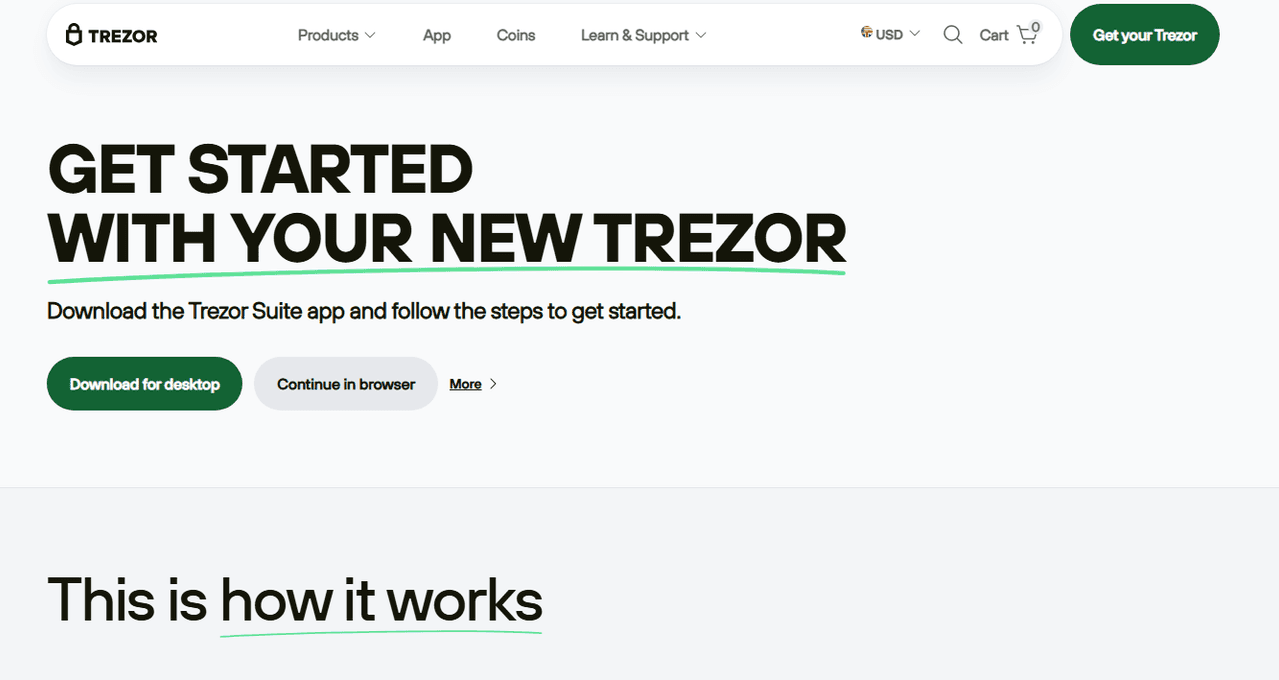
Trezor.io/start – Complete Beginner-to-Advanced Guide for Secure Crypto Wallet Setup
Cryptocurrency ownership comes with freedom—but also responsibility. If you truly want to own your crypto, not just hold it on an exchange, a hardware wallet is essential. That’s where Trezor.io/start comes in. It’s the official starting point for setting up a Trezor hardware wallet safely and correctly.
This guide is written for beginners and mid-level crypto users, gradually moving from simple explanations to deeper security insights. By the end, you’ll understand exactly what Trezor.io/start is, how to use it, common mistakes to avoid, real-world examples, and why it matters so much in today’s crypto environment.
What Is Trezor.io/start?
Trezor.io/start is the official onboarding page created by Trezor, one of the world’s first and most trusted hardware wallet manufacturers. It acts as a secure setup gateway for initializing your Trezor device for the first time.
Instead of plugging your wallet into random software or downloading risky files, Trezor.io/start ensures:
You are using authentic Trezor software
Firmware installation is verified
Your private keys never leave the device
You generate and store your recovery seed securely
Think of Trezor.io/start as the “front door” to your hardware wallet experience.
Why Trezor.io/start Matters in 2025
Crypto scams have evolved. Fake wallet apps, phishing sites, and malicious browser extensions are more common than ever. Many users lose funds not because hardware wallets fail—but because they start in the wrong place.
Using Trezor.io/start protects you from:
Fake Trezor apps
Malicious firmware
Phishing setup pages
Compromised third-party downloads
In crypto terms, this is about self-custody, private key isolation, and cold storage security—three essential pillars of safe crypto ownership.
What You Need Before Visiting Trezor.io/start
Before you begin, prepare the basics:
A new or reset Trezor device (Model One or Model T)
A computer (Windows, macOS, or Linux)
A USB cable (original recommended)
A pen and paper (for recovery seed backup)
A private, distraction-free environment
Never store your recovery phrase digitally. No screenshots. No cloud storage. No phone photos.
Step-by-Step Setup Using Trezor.io/start
Step 1: Go to Trezor.io/start
Open your browser and carefully type Trezor.io/start. Double-check the spelling. Bookmark it for future use.
This page automatically detects your device type and operating system.
Step 2: Connect Your Trezor Device
Plug your Trezor into your computer using a USB cable.
If it’s new, it will prompt firmware installation
If used before, it may ask for PIN verification
At this stage, your device has no private keys stored yet
Step 3: Install Trezor Suite
Trezor.io/start guides you to install Trezor Suite, the official desktop application.
Trezor Suite allows you to:
Manage crypto assets
Send and receive coins
View portfolio balances
Verify transactions on-device
This software acts as an interface, but private keys stay inside the hardware wallet.
Step 4: Firmware Installation (Critical Step)
If your device is new, firmware will not be preinstalled.
Why?
Because preinstalled firmware could be tampered with.
Trezor.io/start ensures:
Firmware authenticity
Cryptographic verification
Tamper-resistant initialization
Never skip this step.
Step 5: Create a New Wallet
You’ll now create a new wallet directly on your Trezor device.
Here’s what happens behind the scenes:
A random seed is generated offline
Your private keys are mathematically derived
Nothing is exposed to the internet
This is the core of cold storage security.
Step 6: Write Down Your Recovery Seed
Your device will display a 12-word or 24-word recovery seed.
This is the most important moment of the entire process.
The recovery seed:
Restores your wallet if the device is lost
Controls access to all funds
Cannot be changed later
Golden rules:
Write it on paper
Store it offline
Never share it
Never type it online
Anyone with this seed owns your crypto.
Step 7: Set a PIN Code
Next, you’ll create a PIN directly on the device.
The PIN:
Protects against physical theft
Uses randomized number positions
Increases brute-force difficulty exponentially
This adds another layer of defense alongside seed protection.
After Setup: What Can You Do?
Once setup through Trezor.io/start is complete, you can:
Send and receive Bitcoin, Ethereum, and thousands of tokens
Interact with DeFi safely
Store NFTs
Use passphrase protection
Connect to third-party wallets securely
You now control your crypto—not an exchange.
Real-World Example: Exchange Collapse vs Self-Custody
Consider this scenario:
A user keeps funds on an exchange during a market downturn. Withdrawals are paused. Accounts are frozen.
Another user:
Set up their wallet via Trezor.io/start
Stored keys offline
Controls assets independently
Only one of them can move funds freely.
This is why self-custody matters.
Common Mistakes to Avoid When Using Trezor.io/start
Even smart users make avoidable errors.
Mistake 1: Using Google Ads Links
Scammers often run fake ads leading to cloned sites.
Always type Trezor.io/start manually.
Mistake 2: Photographing the Recovery Seed
Phones get hacked. Cloud backups leak.
Paper beats pixels.
Mistake 3: Skipping Firmware Updates
Outdated firmware may lack important security patches.
Update only through official Trezor channels.
Mistake 4: Rushing Setup
Take your time. This is financial infrastructure, not a social app login.
Advanced Security Options After Setup
Once comfortable, explore advanced features:
Passphrase Protection
Adds a hidden wallet layer on top of your seed.
Even if someone finds your seed, they can’t access funds without the passphrase.
Multi-Account Structure
Separate holdings for:
Long-term storage
Daily transactions
Experimental DeFi usage
UTXO Management (Bitcoin)
Advanced users can manually control transaction outputs for better privacy.
Trezor.io/start vs Software Wallets
FeatureTrezor Hardware WalletSoftware WalletPrivate Key StorageOfflineOnlineMalware ResistanceHighLowPhishing RiskReducedHighLong-Term StorageExcellentRisky
For serious crypto holders, hardware wallets win.
Crypto Terms Explained (Simple)
Private Key: A secret number that proves ownership of crypto
Recovery Seed: Human-readable backup of private keys
Cold Storage: Offline crypto storage
Self-Custody: You control your funds, not a company
Firmware: Software running directly on hardware wallet
Troubleshooting Issues at Trezor.io/start
Device Not Detected
Try another USB port
Use a different cable
Close other wallet apps
Firmware Install Fails
Restart device
Retry using official software only
PIN Forgotten
Device must be wiped
Restore using recovery seed
This is why the seed matters more than the device itself.
Why Trezor.io/start Is Safer Than Random Downloads
Trezor.io/start acts as a verification checkpoint:
Confirms device authenticity
Prevents supply-chain attacks
Reduces user error
Enforces best security practices
Security isn’t about paranoia—it’s about preparation.
The Bigger Picture: Owning Crypto the Right Way
Crypto was created to eliminate trusted intermediaries. But that only works if users take custody seriously.
Using Trezor.io/start correctly means:
You are your own bank
You reduce counterparty risk
You future-proof your assets
You gain peace of mind
This isn’t just setup—it’s a mindset shift.
Final Thoughts on Trezor.io/start
Trezor.io/start is more than a setup page. It’s the foundation of secure crypto ownership.
If you:
Want long-term holding
Value privacy and control
Believe in decentralization
Care about real security
Then starting at Trezor.io/start is the correct move.
In crypto, mistakes are often irreversible. But good habits—like secure wallet initialization—pay dividends forever.